Define what you are trying to observe.
Before opening an AI tool, decide which result counts. Vague goals such as "show up in AI" make weak tests because they combine several different events.
For the question "Does my business appear in ChatGPT?", the first useful answer is a dated observation: record whether the business was mentioned, recommended, cited, or absent for the exact buyer question and test context. Do not turn one answer into a permanent visibility claim.
Does the answer mention, recommend, or cite the business?
Record these separately. An answer can do more than one. A recommendation can name a single business; it does not need a shortlist. Check the linked page before claiming that a citation supports the answer.
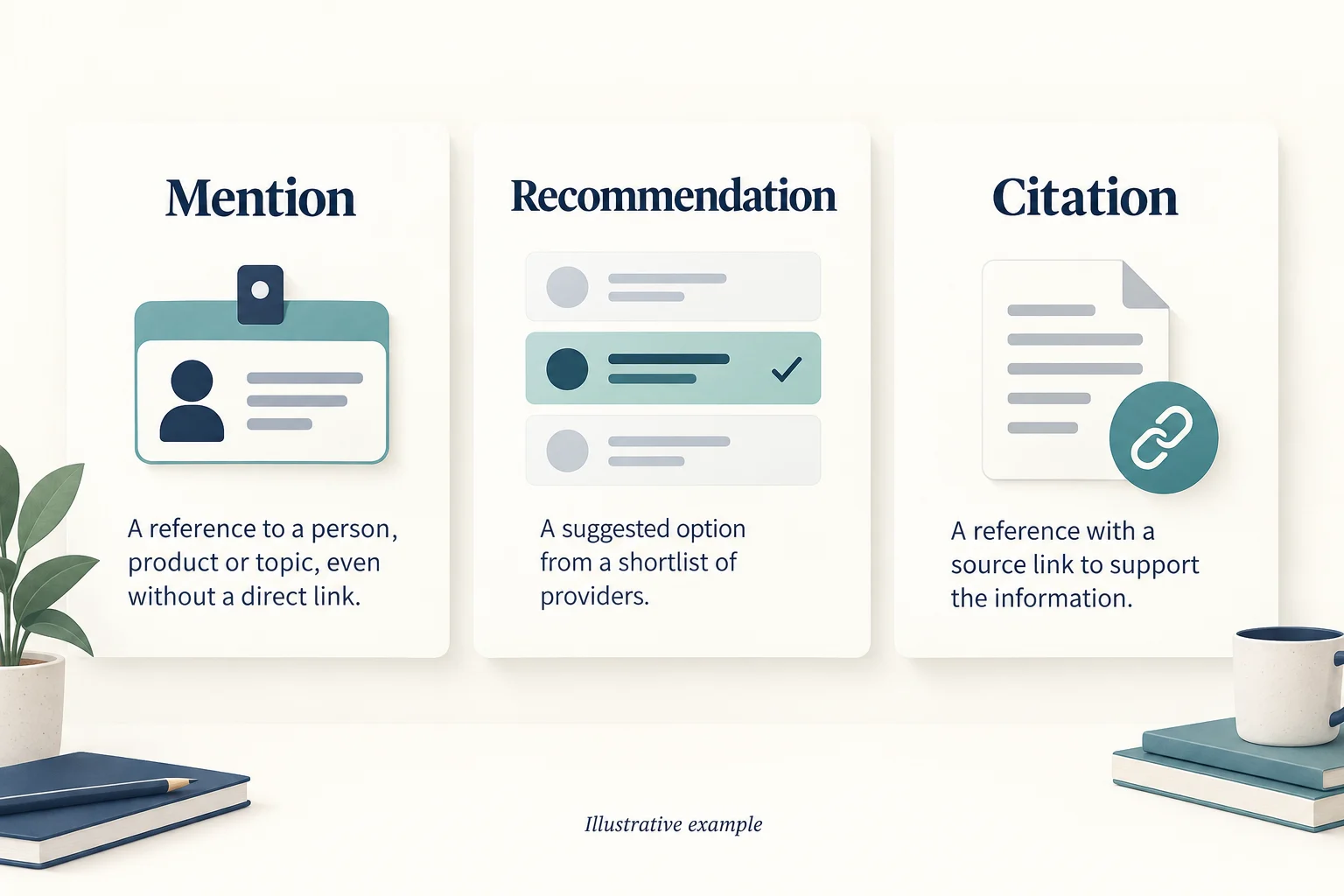
A name, with no suggested choice
Fictional answer: "ExampleCo publishes a maintenance guide." Mark mention: yes. If that is the complete answer, mark recommendation: not observed and visible citation: not observed. Do not infer where the system learned the name.
A suggested provider, with no source link
Fictional answer: "Consider ExampleCo for the service you described." Mark mention: yes and recommendation: yes. Record any qualifications in the answer. Without a visible source reference, citation remains not observed.
A linked source, with no endorsement
Fictional answer: "ExampleCo's guide describes maintenance intervals," followed by a link to that guide. Mark mention: yes and visible citation: yes. Recommendation is not observed unless the answer also presents the company as an option for the buyer's need. Open the exact URL and check whether it supports the quoted claim.
Own website or third-party source? Save the cited domain in its own field. A directory page that names the business is third-party corroboration, not a citation of the business's own website. Neither kind of citation proves a click or an inquiry.
Keep blocked and unrun checks out of the absence count
Use not_run before a query has been attempted. Use blocked when login, rate limits, a tool failure, or missing evidence prevents classification. Use observed or not_observed only after reviewing a captured answer. Record the denominator of completed, classifiable checks beside any summary.
For example, if you prepare ten checks and finish six, report six completed and four unrun or blocked. Do not report four additional absences. This is a reporting example, not an AI Search Crew performance result.
For a starting question set, build the free evidence worksheet. The worksheet prepares the record; it does not run live AI queries or establish visibility.
Test buyer questions, not your company name.
A branded prompt such as "What is Acme?" only checks whether the system can respond to a name it was given. A useful visibility test starts with the decision a buyer is trying to make.
Choose three buyer jobs
Use one category question, one comparison question, and one trust or qualification question. Include the real service and market where location matters.
- "Which firms provide [service] for [buyer type] in [market]?"
- "What are the alternatives for [specific problem]?"
- "Which providers show evidence of [required capability]?"
Freeze the wording
Save the exact prompt. Do not quietly improve it between engines or between the baseline and retest. If a surface asks a follow-up question, record that separately.
Record the test context
Capture the engine and surface, account state if known, date and time, language, stated location, device, and whether web search was visibly active. Answers can vary, so context belongs in the record.
Classify the answer
Mark mention, recommendation, citation, and source as separate fields. Save the cited URLs and the alternatives that appeared. Use "not observed" rather than turning one absence into a universal claim.
Repeat, then compare
Run the same set on the selected surfaces. Retest on a planned date after material site or source changes. Preserve both records instead of replacing the baseline.
Check whether the pages can be retrieved and understood.
AI-search products use different systems, but the basic site checks are concrete. Official guidance from OpenAI, Google, and Perplexity all gives site owners crawler or inclusion controls.123
- Important URLs return a normal successful response without a login wall.
robots.txtdoes not unintentionally block the relevant search crawler.- The page is not marked
noindexwhen it is meant to be discoverable. - The canonical URL points to the public version you want treated as primary.
- The XML sitemap contains the important canonical pages and current modification dates.
- Visible copy states the business name, service, product, audience, and service area accurately.
- Organization, LocalBusiness, Service, Product, or Article structured data matches visible facts.
- JavaScript does not hide the core answer from a basic page response.
These checks establish access and clarity. They do not guarantee selection in an AI answer. Google explicitly frames inclusion in its AI features within the normal Search technical requirements and policies, not a separate guaranteed-placement mechanism.2
Make the business easy to verify.
Your website is the primary record for your own services, but a business also needs accurate public corroboration. Compare the name, domain, locations, categories, leadership, product names, and contact details across legitimate profiles and sources.
First-party evidence
- Clear service and product pages with responsible ownership.
- Method, scope, limitations, current dates, and useful examples.
- Accurate organization, contact, and location information.
- Policies and claims that match what the business actually does.
Independent corroboration
- Relevant professional or trade directories.
- Real customer reviews on legitimate platforms.
- Supplier, association, government, or partner records when applicable.
- Editorial coverage that exists because the work was worth covering.
Keep the raw observation beside the interpretation.
The blank example below shows the minimum fields for a defensible record. It contains no sample performance claims.
| Date and surface | Exact buyer question | Mention | Recommendation | Cited URLs | Alternatives | Notes |
|---|---|---|---|---|---|---|
| Not run | Paste exact prompt | not_run (no answer collected) | not_run (no answer collected) | Paste exact URLs | Record names | Locale, account, web mode, limits |
| Retest date | Same prompt | Record result | Record result | Record result | Record result | State material changes since baseline |
Microsoft's Bing Webmaster Tools now reports AI citations as a distinct performance view across Microsoft answer experiences. That is another reason to keep citations separate from conventional rankings and clicks.4
Say what the test cannot prove.
- One answer does not establish a stable ranking across users, locations, or time.
- A missing mention does not prove that the system has never encountered the business.
- A mention without a visible citation does not identify the source used.
- A citation does not prove that the cited page caused a buyer to choose the business.
- A traffic increase does not establish that the visitor became a qualified lead.
- A technical repair makes a page eligible to be retrieved; it does not guarantee recommendation.
The strongest report is dated, reproducible, and modest about causation. It gives the business a record it can compare after specific improvements.
Platform guidance used in this guide.
- OpenAI, Publishers and Developers FAQ. Covers public-site eligibility, OAI-SearchBot controls, citations, and referral tracking.
- Google Search Central, AI Features and Your Website. Covers eligibility and site guidance for Google's AI search experiences.
- Perplexity, Perplexity Crawlers. Lists crawler user agents and robots.txt controls.
- Bing Webmaster Blog, Introducing AI Performance in Bing Webmaster Tools. Describes citation reporting for Microsoft AI answer experiences.
- Google Search Central, Robots Meta Tags Specifications. Defines page-level indexing and snippet controls.
Start with the question set and an evidence worksheet.
Use the free worksheet to record prompts, engines, mentions, citations, alternatives, and retest dates without pretending a query was run.
Build the free evidence worksheet